Popular Posts

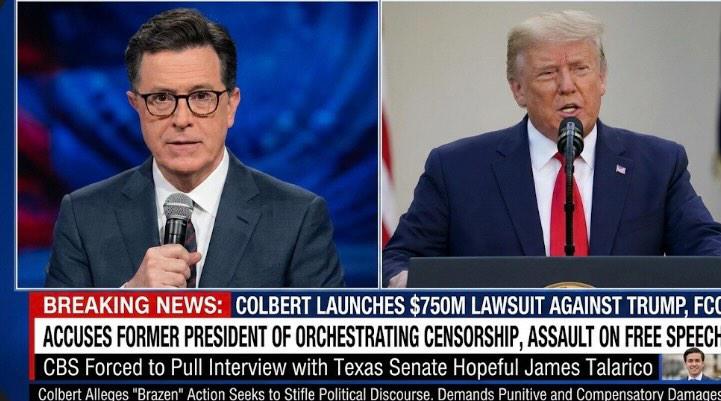
JUST IN: Stephen Colbert Launches $750 Million Federal Lawsuit Against FCC and Donald Trump in Punitive and Compensatory Damages , Accusing Trump of Orchestrating Brazen Censorship and a Direct Assault on Press Freedom and Free Speech by Forcing CBS to Pull Interview with Texas Senate Hopeful James Talarico

Spread the love


In a stunning escalation that is sending shockwaves through media and political circles, late-night television icon Stephen Colbert has reportedly filed a $750 million federal lawsuit against the Federal Communications Commission and Donald Trump, accusing them of orchestrating what he calls a brazen act of censorship and a frontal attack on the First Amendment.

🔥 The Allegations
According to the claims, Colbert argues that political pressure and regulatory intimidation were used to force CBS to pull a scheduled interview with Texas Senate hopeful James Talarico, silencing a lawful political voice during a critical election period.
Colbert alleges that:
The FCC, under Trump-era influence, weaponized broadcast rules to intimidate networks
CBS caved to pressure and blocked the interview from airing
The move constituted unconstitutional censorship, violating free speech and press freedom
⚖️ What the Lawsuit Seeks
The lawsuit reportedly demands $750 million in punitive and compensatory damages, citing:
Irreparable harm to journalistic independence
Chilling effects on political speech
Abuse of federal regulatory power for partisan ends
Colbert is said to argue that allowing government officials to influence who can speak on national television sets a dangerous precedent, one that threatens the foundation of a free press in America.
📺 A Media Firestorm
The alleged censorship has already ignited widespread backlash:
Press freedom advocates warn this could mark a turning point for political speech on broadcast media
Critics say entertainment programs are being dragged into partisan regulatory battles
Supporters argue the attempt to suppress the interview backfired, amplifying both Colbert’s message and Talarico’s campaign
🇺🇸 Why This Matters
If proven, the lawsuit could become one of the most consequential legal battles over media independence and government overreach in modern U.S. history — testing whether federal regulators can indirectly control political narratives by intimidating broadcasters.
As the story continues to unfold, one thing is clear:
🔥 The fight over who controls the microphone in America has entered a new and explosive phase.
 

Supreme Court Blocks Donald Trump’s Proposal to Slash SSI and Veterans Benefits to Redirect Billions to DHS as Homeland Security Shutdown Deepens

Supreme Court Blocks Trump Plan to Redirect SSI and Veterans Benefits to DHS Amid Funding Standoff

In a major constitutional showdown, the supreme court’l of the United States has blocked a controversial proposal backed by former President that sought to reduce funding for Supplemental Security Income (SSI) and veterans benefits in order to reallocate billions of dollars to the Department of Homeland Security (DHS).

The ruling comes as DHS faces a partial shutdown triggered by a deepening funding impasse in Congress. Lawmakers have been locked in negotiations over border security allocations, immigration enforcement priorities, and broader federal spending levels. With no agreement in place, portions of Homeland Security operations have slowed, intensifying pressure on both the White House and Capitol Hill.
The Proposal at the Center of the Fight

According to court filings, the Trump-backed plan would have temporarily reduced certain SSI and veterans benefits allocations, arguing that emergency executive authority allowed for limited reprogramming of federal funds during a national security crisis. Supporters of the proposal claimed the move was necessary to maintain border operations, immigration enforcement, and national security readiness amid the congressional deadlock.

Critics, however, argued that the executive branch does not have unilateral authority to redirect congressionally appropriated funds—especially from entitlement programs such as SSI and veterans benefits, which are considered legally protected mandatory spending.

Several advocacy groups representing seniors, disabled Americans, and military veterans quickly filed suit, contending that the proposal violated the Constitution’s Appropriations Clause, which grants Congress—not the president—the power of the purse.

The Court’s Decision

In its emergency order, the Supreme Court temporarily halted implementation of the plan, effectively preserving SSI and veterans benefits funding while the legal challenge proceeds. Though the Court did not issue a full opinion explaining its reasoning, the order signals serious constitutional concerns about executive authority to alter congressionally designated funding streams.

Legal analysts say the decision underscores a fundamental separation-of-powers principle: presidents cannot rewrite spending laws passed by Congress, even during politically charged funding crises.

“This is a clear reminder that federal entitlement programs cannot be used as bargaining chips in budget standoffs,” one constitutional law scholar noted following the ruling.

Political Fallout

The decision represents a significant setback for Trump and his allies, who have framed the DHS shutdown as a direct consequence of congressional inaction. Supporters argue that extraordinary measures were justified to prevent disruptions to border security and homeland operations.

Opponents counter that shifting funds from vulnerable populations—particularly low-income seniors, disabled Americans, and military veterans—would have set a dangerous precedent.

On Capitol Hill, reactions split largely along party lines. Some lawmakers called the ruling a victory for constitutional checks and balances, while others criticized the Court for what they described as interference in urgent national security matters.

What Happens Next

For now, SSI recipients and veterans will continue receiving full benefits as previously authorized by Congress. The broader funding dispute over DHS remains unresolved, however, and negotiations are expected to intensify in the coming days.

The legal battle could return to the Supreme Court for a full hearing, potentially resulting in a landmark ruling that clarifies the limits of presidential authority in federal budget emergencies.

As the standoff continues, the case has become a flashpoint in the larger debate over executive power, fiscal responsibility, and the protection of America’s most vulnerable citizens.


Spread the love

Leave a Reply

Your email address will not be published. Required fields are marked *